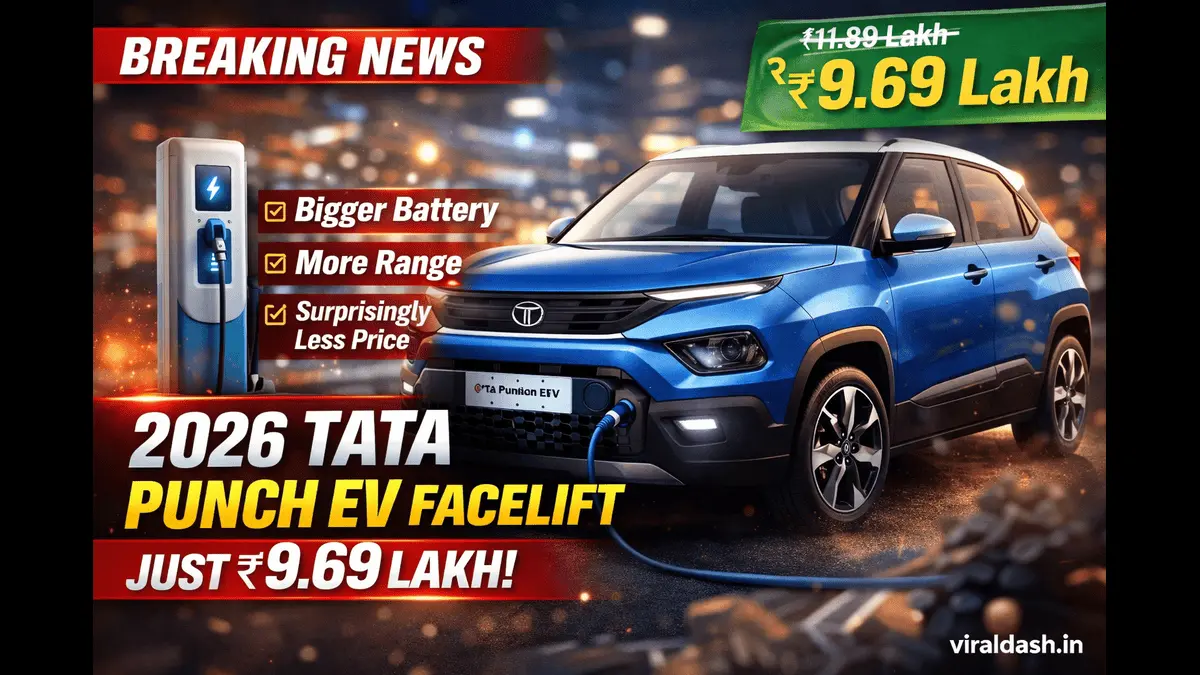
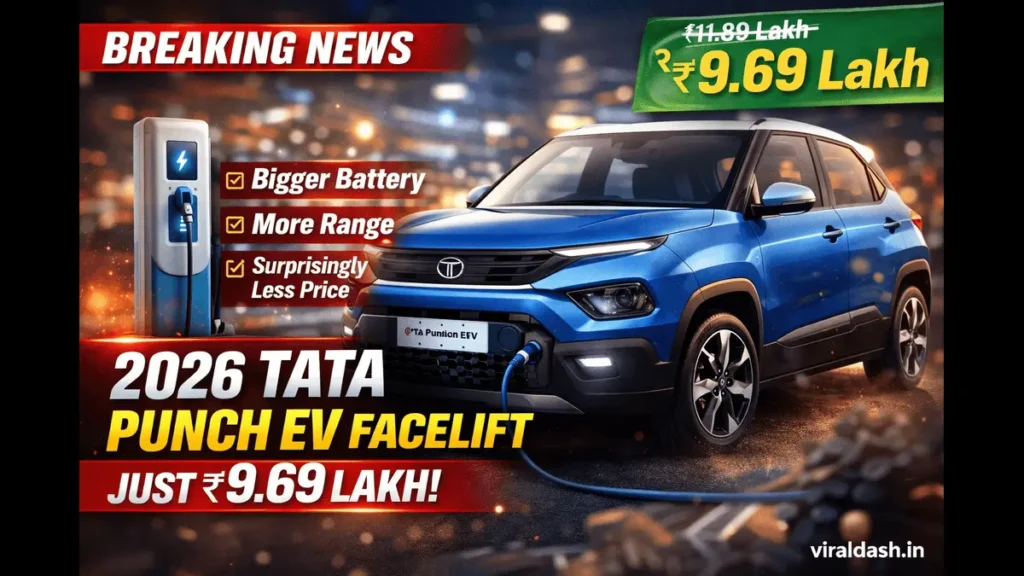
Just when you thought the Tata Punch EV had already done enough to earn its place as India’s most accessible electric SUV — Tata Motors went and made it even better. The 2026 Tata Punch EV facelift has officially landed in India, and honestly, it is the kind of update that makes practical sense rather than just cosmetic sense.
Launched on February 20, 2026, the facelifted Punch EV comes with bigger battery packs, noticeably improved range numbers, refreshed styling that feels more grown-up, and — here is the part that will genuinely surprise people — a lower starting price than the model it replaces. Prices now range between ₹9.69 lakh and ₹12.59 lakh (ex-showroom), with the Battery-as-a-Service (BaaS) model opening the door even wider at just ₹6.49 lakh.
So what exactly is new, what has been carried over, and most importantly — should you be excited? Let us break it all down.
A Familiar Face With a Fresher Look
Let us be honest — the Punch EV facelift is not trying to reinvent the wheel, and it does not need to. The design updates are more about refinement than revolution, and that approach works quite well here.
Up front, the connected LED light bar from the older model has been dropped. In its place, you now get sleek LED DRLs positioned at the outer edges of the front fascia, giving the Punch EV a cleaner, more contemporary face. The bumper has been redesigned too, featuring a larger air dam and a textured silver faux skid plate that replaces the plain black strip of the outgoing car. The result is a front end that feels more purposeful and less busy.
The split headlamp setup with triangular pods remains, and the charging port position stays the same — though the overall look around it feels tidier and more minimalist than before.
From the sides, very little has changed. You still get the tall-boy stance, blacked-out ORVMs with integrated turn indicators, roof rails, thick body cladding, and 16-inch alloy wheels. The silhouette is unmistakably Punch, which is not a bad thing.
The most noticeable exterior change is actually at the rear. The facelift now features a connected full-width LED tail-lamp setup, borrowing the same design language from the ICE-powered Punch that launched recently. It is a meaningful upgrade that ties the electric and petrol versions of the Punch together visually, and makes the EV look significantly more premium from behind.
Three new colour options — Fearless Yellow, Bengal Rouge, and Caramel — have been added to the palette, bringing the total to seven shades. If you want to stand out, the Fearless Yellow is genuinely hard to ignore.
Ground clearance has also gone up slightly to 195 mm, about 5 mm higher than before — a small but welcome change for city roads that are not exactly pothole-free.
Inside: Familiar Territory, Cleaner Touches
Step into the cabin and you will notice that the overall layout has not changed dramatically. The freestanding 10.25-inch touchscreen infotainment system still sits at the centre of the dashboard, and the 10-inch fully digital instrument cluster carries forward as well.
What has changed is the dual-tone colour scheme. The earlier black-and-white cabin has made way for a grey and white Udaipur-themed interior, which feels lighter and slightly more upmarket. The leatherette upholstery gets refreshed shades to match, and the overall vibe inside feels fresher even if the bones are the same.
The two-spoke illuminated steering wheel remains, and the centre console design stays largely unchanged. One practical addition worth mentioning — Tata has replaced the older power window switches with new toggle-style units that feel more intuitive to use. Small detail, but you notice it every single day.
Rear seat space is unchanged, which means it is still adequate for a city SUV of this size. Legroom is not class-leading, but it gets the job done for daily commutes and weekend drives.
Features: The Useful Additions
Tata has not thrown in features just for the sake of a spec sheet. The additions are practical and genuinely useful.
New to the 2026 Punch EV are OTA (over-the-air) software updates, which means the car gets better over time without a trip to the service centre. Voice commands now support six languages, which makes interaction far more natural for a wider range of buyers. Smartwatch connectivity is another new addition, and the inclusion of a blind-spot monitor and a high-beam alert feature rounds off the safety-focused upgrades well.
Everything that made the pre-facelift model worth considering is still here — wireless Apple CarPlay and Android Auto, auto climate control, ventilated front seats, a wireless phone charger, cruise control, paddle shifters for regenerative braking (four levels), connected car technology, and a sunroof.
Safety, as always with Tata, is taken seriously. The Punch EV facelift comes with 6 airbags as standard, ABS with EBD, electronic stability control, an electronic parking brake with auto-hold, a 360-degree surround-view camera, hill hold assist, hill descent control, and a tyre pressure monitoring system. That is a strong package at this price point.
The Real Story: Bigger Batteries and Proper Range
This is where the 2026 Punch EV facelift separates itself from its predecessor in a meaningful way.
The outgoing model was offered with 25 kWh and 35 kWh battery packs. The facelift replaces both with larger 30 kWh and 40 kWh units, and the difference in real-world usability is significant.
| Spec | 30 kWh (Facelift) | 40 kWh (Facelift) | 25 kWh (Old) | 35 kWh (Old) |
|---|---|---|---|---|
| Claimed Range (MIDC) | 365–375 km | 468 km | 265 km | 365 km |
| Power | 88 PS | 129 PS | 81 PS | 122 PS |
| Torque | 154 Nm | 154 Nm | 114 Nm | 190 Nm |
| 0–100 kmph | 13.5 sec | 9 sec | 13.5 sec | 9.5 sec |
The top-spec 40 kWh variant’s claimed range of 468 km is a big leap from the earlier 365 km — around 100 km of additional range that takes real-world anxiety out of longer drives. Real-world figures from the 40 kWh pack are expected to hover around 355 km, which is genuinely usable.
Fast charging has also improved. With an optional 65 kW DC fast charger, the Punch EV can go from 20 to 80 percent in just 26 minutes. At home, a 7.2 kW AC charger is supported for overnight top-ups. And in what is a first for this segment — Tata is offering a lifetime unlimited-kilometre battery warranty on the 40 kWh pack for the first owner. That is the kind of confidence that removes a major concern for first-time EV buyers.
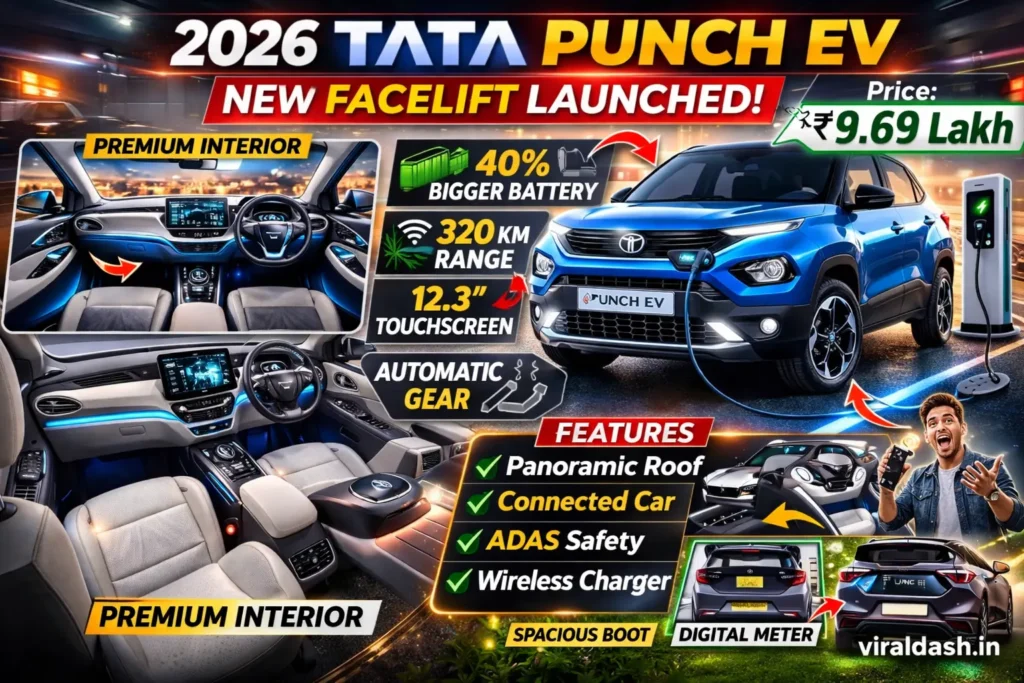
BaaS: Making EVs Accessible to More People
The Battery-as-a-Service model that Tata introduced with the Nexon EV has now made its way to the Punch EV, and this could be a game-changer for buyers who are on the fence about EV ownership.
Under BaaS, the base Smart 30 variant starts at just ₹6.49 lakh (ex-showroom) — you pay a per-kilometre charge of ₹2.6 for the battery separately. It drastically lowers the upfront cost and makes electric mobility more accessible than ever at this end of the market.
Variant-Wise Pricing (Without BaaS)
| Variant | Battery | Price (Ex-Showroom) |
|---|---|---|
| Smart | 30 kWh | ₹9.69 lakh |
| Smart+ | 30 kWh | ₹10.49 lakh |
| Adventure | 30 kWh | ₹11.19 lakh |
| Empowered | 40 kWh | ₹11.99 lakh |
| Empowered+S | 40 kWh | ₹12.59 lakh |
Compared to the old model that topped out at ₹14.44 lakh, the new Punch EV facelift is ₹2.5 to ₹3 lakh cheaper across variants. More range, more features, better battery, lower price — Tata has genuinely delivered value here.
Who Should Be Considering This?
If you are a first-time EV buyer who wants a compact, practical electric SUV without burning a hole in your wallet, the 2026 Punch EV facelift makes a compelling case. It is designed for city life, but the improved range on the 40 kWh variant means occasional highway runs no longer need to be stress-inducing.
Buyers who were eyeing the Tata Nexon EV but found it a bit large or a bit expensive should absolutely take a second look at the Punch EV facelift. The price gap between the two has narrowed the decision, not widened it.
In terms of competition, the Punch EV facelift goes up against the Citroen eC3 directly, while also brushing shoulders with the MG Windsor EV and Mahindra XUV 3XO EV further up the pricing ladder.
Final Word
The 2026 Tata Punch EV facelift is proof that not every update needs to be dramatic to be effective. Tata has been smart about where it spent its engineering resources — the battery upgrades and range improvements will matter to real buyers every single day. The cosmetic changes are clean and contemporary without being gimmicky. The new features add genuine utility. And the pricing? Well, the fact that you now get a more capable car for less money than before is not something that happens very often in the Indian auto market.
This is one of those updates that makes an already good product better in ways that actually matter.
Also Read:
Renault Duster 2026 Review : Adventure Ready SUV with Smart Features and Bold Performance
Royal Enfield Meteor 350 – Smooth Cruiser With Modern Tech & Comfortable Ride