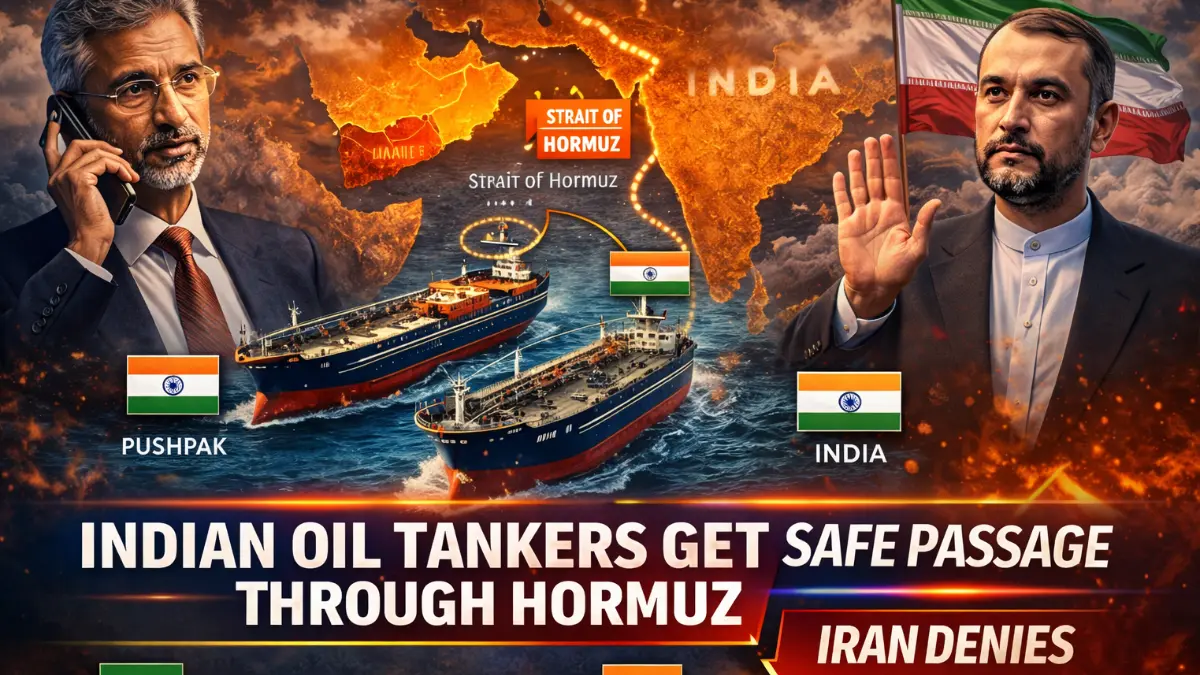
While the rest of the world watched tankers pile up outside the most dangerous stretch of ocean on earth, two Indian ships quietly sailed through.
The Pushpak and the Parimal — both India-flagged oil tankers — have been navigating the Strait of Hormuz safely, according to Indian government sources. Ships from the United States, Europe, and Israel meanwhile continue to face restrictions, targeting, or outright blockade in the same waters. A Liberian-flagged vessel carrying Saudi crude, captained by an Indian, also made it through and docked in Mumbai — becoming the first India-bound ship to safely transit the waterway since maritime traffic there effectively ground to a halt following the US and Israeli strikes on Iran.
The quiet breakthrough, if it holds, matters enormously for India. And it appears to be the result of a phone call.
The Call That May Have Changed Things
External Affairs Minister S. Jaishankar held a telephonic conversation with his Iranian counterpart Seyed Abbas Araghchi on Tuesday evening, March 10 — the third time the two ministers have spoken since the US and Israel jointly launched military strikes on Iran.
The first call happened on February 28, the day the strikes began. The second followed on March 5, after Iran’s Supreme Leader Ayatollah Ali Khamenei was killed. By the third call, the conversation had shifted toward something more operational.
Ensuring the safe navigation of tankers through the Strait of Hormuz figured prominently during the discussion. The two leaders talked through the evolving situation in West Asia, and maritime movement through the strait was a key point on the table.
Jaishankar’s public statement on X afterward was measured — “A detailed conversation this evening with Foreign Minister Araghchi of Iran on the latest developments regarding the ongoing conflict. We agreed to remain in touch.” The Iranian foreign ministry was considerably more expansive in its readout, detailing what Araghchi described as crimes committed by the United States and Israel, including a missile strike on a girls’ elementary school in Minab on the first day of the war and subsequent attacks on civilian sites and public service centres.
Sources said the objective of the diplomatic engagement on India’s side was clear — to keep the sea route open for Indian vessels so that shipments of crude oil and liquefied natural gas continue without major disruption. Jaishankar also reached out to Russian Foreign Minister Sergey Lavrov and French counterpart Jean-Noël Barrot around the same time, pushing the broader case for stable shipping lanes in the Gulf.
What Is Actually Happening at the Strait
To understand why this diplomatic outcome matters so much, you need to understand just how bad the situation at the Strait of Hormuz has become.
On March 2, a senior IRGC official confirmed that the strait was effectively closed, threatening any ship that attempted to pass through it. Tanker traffic dropped by approximately 70 percent initially, with over 150 ships anchoring outside the strait to avoid the risk. Soon afterward, traffic dropped to nearly zero.
The IRGC has not been bluffing. Several vessels have been struck — a US-flagged tanker at the port of Bahrain was hit twice, causing a fire; another vessel was targeted after attempting to cross; and on March 6, a tugboat dispatched to help a stricken ship was struck by two missiles and sank, leaving crew members missing. US military intelligence separately reported that Iran had begun planting naval mines in the Strait of Hormuz as of March 10.
More than 20 million barrels of crude oil pass daily through the narrow channel separating the Iranian coast from Oman — roughly a fifth of global oil consumption and nearly a quarter of all seaborne oil trade. When that flow falters, the consequences reach far beyond the Gulf.
What makes India’s situation different is one important distinction. On March 5, the IRGC announced that Iran would keep the Strait of Hormuz closed specifically to ships from the US, Israel, and their Western allies — a position it confirmed again on March 8. That framing opened a narrow lane of possibility for countries like India that have maintained diplomatic channels with Tehran throughout the conflict.
The Contradiction Nobody Is Resolving
Here is where the story gets complicated — and where it is important to be honest about what we do not know.
On March 12, Reuters reported that Iran would allow India-flagged tankers to pass through the Strait of Hormuz, citing an Indian source. In the same report, an Iranian source denied that any such allowance had been made.
Those two sentences were published in the same dispatch. Two governments, two directly opposite versions of events.
Iran’s broader public position throughout the conflict has been unambiguous — the Iranian Revolutionary Guards have repeatedly stated that no ship will be allowed to pass, and that not one litre of oil will flow through the Strait while US and Israeli attacks on Iran continue. Tehran has attacked multiple commercial tankers, causing fires and crew casualties. There have been reports of mines being laid in shipping lanes.
Against that backdrop, an official Iranian denial is at least consistent with everything Tehran has said since late February. The Indian government’s version — that named vessels are transiting safely as a result of the Jaishankar-Araghchi talks — is harder to dismiss because maritime tracking data appears to support some of it. According to Lloyd’s List Intelligence and TankerTrackers, the Shenlong Suezmax vessel loaded Saudi crude at Ras Tanura on March 1, departed on March 3, and its last recorded location before reaching Indian waters showed it inside the Strait of Hormuz on March 8.
Ships are moving. Whether Iran formally sanctioned that movement or simply chose not to intercept it in these specific cases is a question that, as of today, remains unanswered.
India’s Energy Stakes Are Not Small
The reason New Delhi has been working this diplomatic channel so hard comes down to one number: dependence.
India imports over 88 percent of its oil. For New Delhi, the Strait of Hormuz is not merely a trade route — it is an economic artery. Nearly half of India’s total crude imports had been transiting through the strait in the months leading up to this crisis. The LPG situation is even more acute. India imports about 60 percent of its LPG consumption, and nearly 90 percent of those imports normally pass through the Strait of Hormuz.
The Indian government has been moving quickly to diversify. Officials said India now imports crude oil from around 40 countries, and about 70 percent of its crude imports are now coming through routes outside the Strait of Hormuz — up from around 55 percent earlier. That shift has cushioned the immediate blow. But the LPG crunch is harder to reroute, and cooking gas shortages have already hit households across the country, with cylinder prices rising sharply and black-market rates in some areas reportedly reaching ₹3,000.
In response, the government issued a Natural Gas Control Order on March 9 under the Essential Commodities Act, protecting domestic piped gas and CNG supply at 100 percent while cutting allocations to refineries and petrochemical units by 35 percent to prioritise household and fertiliser needs.
At present, 28 Indian-flagged ships are operating in or near the Strait of Hormuz, with 677 Indian sailors onboard. Their safety is both a diplomatic and a humanitarian concern for New Delhi.
What India’s Diplomatic Balancing Act Actually Looks Like
India’s ability to even have this conversation with Iran rests on a relationship that most Western nations cannot replicate right now.
New Delhi has not condemned the US-Israeli strikes on Iran. It has also not endorsed them. It has called for dialogue, expressed concern about civilian casualties, and kept its foreign minister on the phone with Tehran through three separate rounds of escalation. That studied neutrality — which has drawn criticism from some quarters — is precisely what creates the space for conversations about tanker exemptions.
During the March 5 call, Iran’s Foreign Minister Araghchi expressed his country’s thanks for India’s “humane gesture” in allowing the Iranian naval vessel IRIS Lavan to dock in Kochi due to technical issues — a small act of goodwill that likely carried more weight in Tehran than any formal statement of solidarity would have.
Iran’s position during the latest call was that instability affecting maritime movement in the region was a direct result of aggressive and destabilising actions by the United States, and called on the international community to hold Washington accountable. India listened. It did not agree. It kept the conversation going.
That is, for now, what Indian diplomacy in this crisis looks like — quiet, transactional, and focused on outcomes rather than positions.
What Happens Next
Even if India has secured some form of informal passage arrangement, the picture is not stable. Shipping industry sources note that even if Iran has agreed not to target Indian-flagged vessels, insurance underwriters and shipping companies are not operating on the basis of diplomatic claims. War risk premiums for Hormuz transit remain at extreme levels. Until physical evidence accumulates over days rather than hours, the insurance and shipping industry will not treat any exemption as durable.
The broader closure of the strait, affecting roughly a fifth of global crude and significant LNG volumes, remains in effect for the vast majority of shipping. An Indian exemption, even if real, is a temporary carve-out inside a much larger crisis — not the resolution of it.
What is clear is that India is one of the very few countries in the world with enough diplomatic standing in Tehran right now to even ask the question. Whether that standing holds as the war deepens is a different matter entirely.
For now, the Pushpak and the Parimal are moving. And in the middle of a crisis this severe, that counts for something.
ALSO READ:
Did Israel Attack North Korea’s Embassy in Tehran? Fact-Checking the Viral Missile Strike Claim