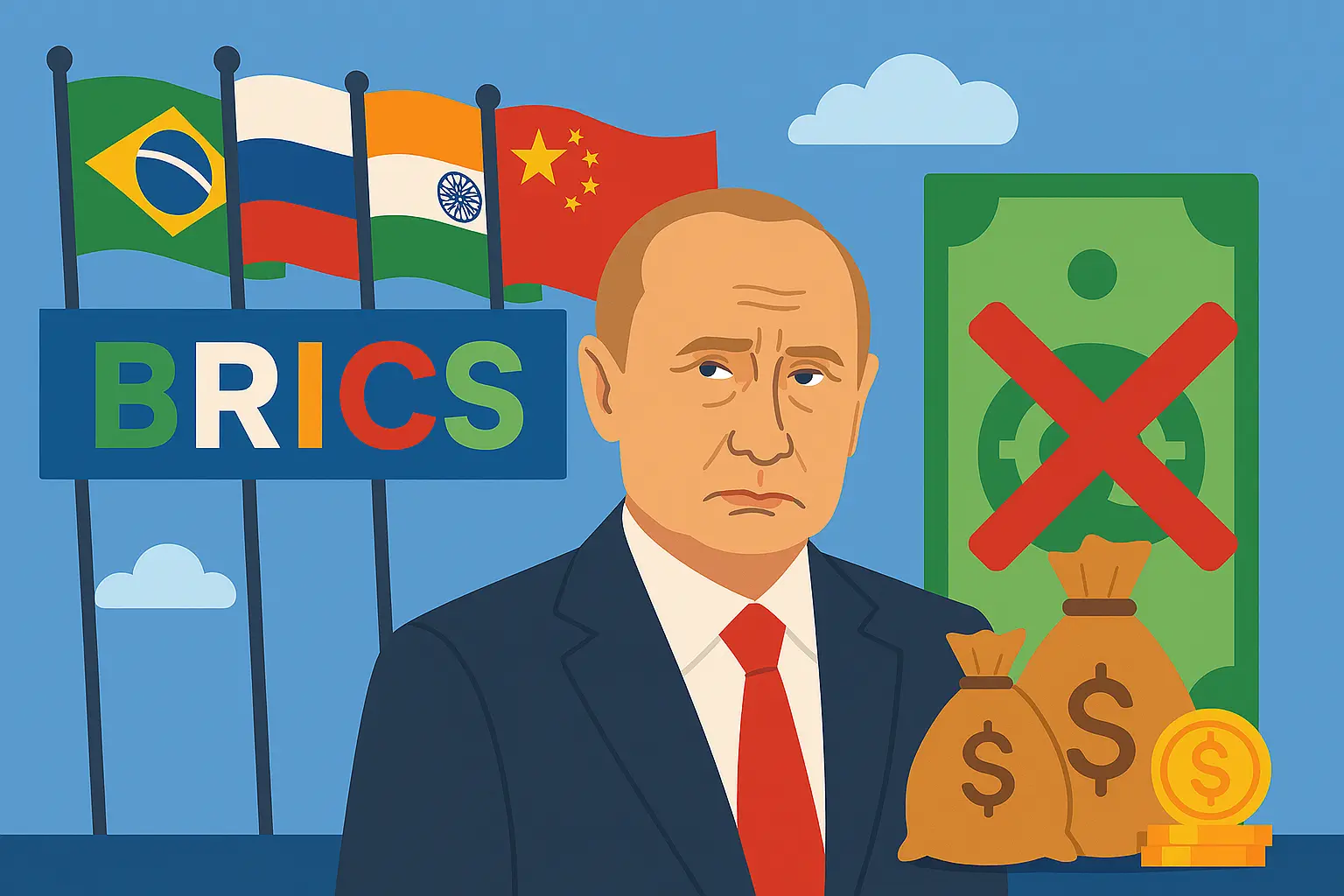
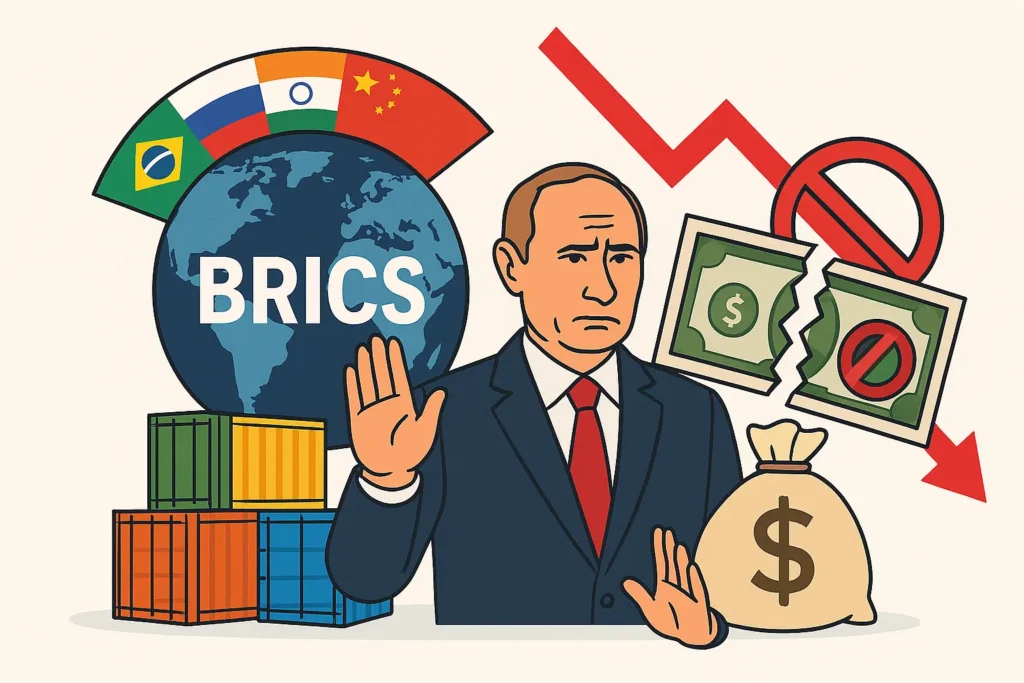
In a bold move that reignited global debate over currency dominance, Russian President Vladimir Putin opened the expanded BRICS summit in Kazan with a call to dismantle the dollar’s grip on international finance. Framing the U.S. currency as a geopolitical weapon, Putin urged member nations to accelerate efforts toward an alternative payments system—one that could insulate them from Washington’s influence.
“The dollar is standing as a weapon. We really see that this is so. I think that this is a big blunder by those who do this,” Putin declared, noting that 95% of Russia-China trade is now shown in rubles and yuan.
Yet despite the rhetoric, the summit’s final communiqué revealed little tangible progress. The proposal to bypass SWIFT—the Belgium-based global payments network—remains aspirational, with technical and political hurdles still unresolved.
A Divided Bloc
Putin’s push for de-dollarisation has unsettled key BRICS members, particularly Brazil and India, who fear the bloc could drift into an overtly anti-Western posture. Both nations have emphasised the need for BRICS to remain a platform for inclusive development rather than geopolitical confrontation.
The Dollar Dilemma
Since World War II, the U.S. dollar has served as the world’s reserve currency, accounting for nearly 60% of central bank holdings and facilitating over 80% of global trade transactions. Its dominance allows the U.S. to borrow cheaply and exert influence through sanctions and financial restrictions.
For Russia, which has been largely cut off from dollar-based systems since its 2022 invasion of Ukraine, the urgency to find alternatives is acute. But for other BRICS members, the dollar’s stability and liquidity remain indispensable.
Agathe Demarais of the European Council on Foreign Relations noted:
“At this stage it is hard to imagine a widespread development and adoption of BRICS financial tools globally.”
Trade Realities and Currency Challenges
India’s imports from Russia—primarily crude oil—have surged since the Ukraine war, reaching $61.43 billion in FY 2023–24, a 33% increase over the previous year. Russia is now India’s second-largest exporter after China. However, the lack of a direct rupee-rouble exchange rate complicates trade settlements.
A banking source explained:
“If we have a direct exchange rate, we do not have to peg it to any currency, including the dollar. But that would need rupee and rouble to be traded in the exact currency exchange platform for a considerably larger quantity and for a longer duration.”
Accumulated rupee balances in Indian banks held by Russian firms have reportedly dropped to a few million dollars, down from earlier estimates in the billions, as the surplus was used to pay Indian exporters.
The Technical Roadblocks
Creating a viable alternative to the dollar is no small feat. Even the euro—backed by 20 nations and the European Central Bank—took decades to materialize. BRICS discussions have floated ideas like a digital asset backed by a basket of emerging market currencies, but coordination remains elusive.
The Kazan Declaration offered only vague commitments to “make the international monetary and financial system more equitable and fair.” Analysts say the BRICS Cross-Border Payments Initiative (BCBPI), aimed at enabling local currency settlements, is still voluntary and non-binding.
Geopolitical Undercurrents
The summit also marked Putin’s most prominent international appearance since the Ukraine invasion. Hosting 36 heads of state, including UN Secretary-General António Guterres, the event drew criticism from Kyiv, which accused Guterres of snubbing its peace conference while meeting a leader under ICC indictment.
The final communiqué included a muted reference to a Brazil-China peace plan for Ukraine, while reserving stronger language for condemning Israel’s actions in Gaza. Ukrainian President Volodymyr Zelenskyy dismissed the BRICS proposal as a “half-hearted settlement plan” that would only embolden Moscow.
Putin reiterated that Russia would not relinquish control of four eastern Ukrainian regions, while Chinese President Xi Jinping discussed the war privately with him.
Expansion and Identity Crisis
Now in its 16th year, BRICS faces an identity crossroads. With growing interest from the Global South, the bloc is set to admit 12 new members—including Cuba, Bolivia, Thailand, Vietnam, Malaysia, Indonesia, Belarus, Turkey, Nigeria, Uganda, Kazakhstan, and Uzbekistan. Turkey’s participation, as a NATO member, has raised eyebrows.
Brazil and India have pushed back against admitting Venezuela, successfully vetoing its entry to prevent BRICS from becoming a mouthpiece for authoritarian regimes.
Trump’s Counterpunch
As BRICS flirts with de-dollarization, former U.S. President Donald Trump is doubling down on defending the dollar’s supremacy. Eyeing a return to the White House, Trump has pledged steep tariffs on countries that abandon the dollar.
His campaign underscores a renewed commitment to economic nationalism, framing the dollar’s dominance as a cornerstone of U.S. power.
Would you like this adapted into a policy brief, op-ed, or infographic next? I can also help craft a headline and teaser for publishing.