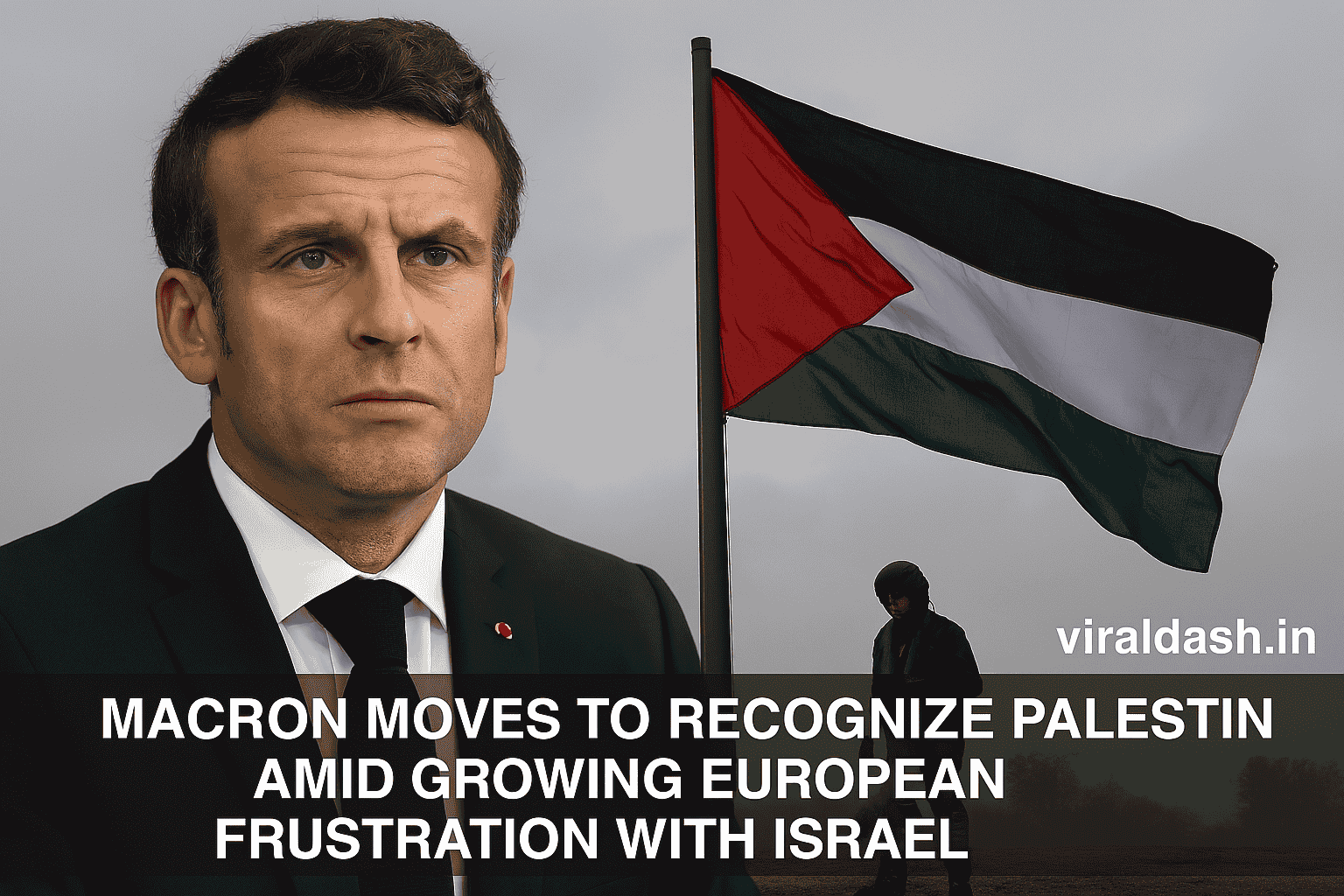
In a major geopolitical development, French President Emmanuel Macron announced that France will formally recognize the State of Palestine, signaling a significant shift in European diplomacy amid the ongoing war in Gaza. The declaration comes as international pressure mounts on Israel over its military actions and worsening humanitarian conditions in the besieged enclave.
“True to its historic commitment to a just and lasting peace in the Middle East, I have decided that France will recognize the State of Palestine,” Macron said in a public statement on Thursday. He pledged to make the move official during a United Nations summit in September.
Highlighting the urgency of the moment, Macron added, “The immediate priority is ending the war in Gaza and delivering humanitarian assistance to civilians.” He called on Israelis, Palestinians, and the broader international community to reaffirm the belief that peace is still possible.
European Unity and Growing Criticism of Israel
Macron’s move has reignited momentum across Europe, where several leaders have recently taken a harder line against Israel’s ongoing military campaign. British Prime Minister Keir Starmer swiftly convened an emergency call with France and Germany—the U.K.’s E3 partners—to discuss urgent measures to end the violence and facilitate aid deliveries.
Calling the conditions in Gaza “unspeakable and indefensible,” Starmer reiterated the Palestinian people’s “inalienable right” to statehood.
Spain, a vocal advocate for Palestinian recognition, welcomed France’s decision. “Together, we must protect what Netanyahu is trying to destroy,” said Spanish Prime Minister Pedro Sánchez. “The two-state solution remains the only viable solution.” Ireland also praised France’s announcement as a vital diplomatic step forward.
So far, 11 out of the European Union’s 27 member states—including Sweden, Romania, Ireland, Spain, and Bulgaria—have formally recognized Palestinian statehood.
Backlash from Israel and the United States
Israel responded with fierce criticism. Prime Minister Benjamin Netanyahu said Macron’s decision could embolden extremists. “A Palestinian state under these conditions would not coexist with Israel—it would be used as a base to destroy it,” he warned.
Israeli Defense Minister Israel Katz went further, denouncing Macron’s statement as “a disgrace” and “a reward for terrorists,” referencing Hamas’ deadly attacks on October 7. He likened the move to “surrendering to terror” and accused France of undermining the memory of Holocaust victims.
The United States also reacted strongly. Secretary of State Marco Rubio said Washington “strongly rejects” France’s decision, calling it “a slap in the face” to those impacted by Hamas’s attacks. “This reckless move only strengthens Hamas propaganda and delays peace efforts,” Rubio wrote on X.
Mounting Death Toll and International Alarm
As the conflict drags on, the humanitarian toll in Gaza has become a rallying point for European outrage. According to Gaza’s health ministry, nearly 60,000 people have died since the war began. The United Nations has warned of severe shortages in food, water, and medicine, accusing Israel of obstructing critical aid deliveries.
“People in Gaza are neither dead nor alive—they are walking corpses,” said Philippe Lazzarini, head of the U.N. Relief and Works Agency (UNRWA). The agency has reported widespread starvation-related deaths.
European Commission President Ursula von der Leyen recently described the situation in Gaza as “unbearable,” urging an immediate end to hostilities. Meanwhile, Italian Prime Minister Giorgia Meloni, typically a staunch ally of Israel, expressed outrage over an Israeli strike on a Catholic church that killed three civilians. She condemned the broader conduct of the war, calling the deaths of non-combatants “unacceptable.”
Though Italy has not yet recognized Palestine, Meloni’s comments marked a noticeable shift in tone and underscored growing European frustration with Israel’s approach.
A New Diplomatic Reality
France’s recognition of Palestine may be the clearest indication yet that the European tide is turning. While not all EU nations are aligned, there is growing consensus that a two-state solution must be revived—and that unconditional support for Israel may no longer be politically or morally sustainable.
As diplomatic efforts intensify ahead of the UN summit in September, the spotlight remains on whether other major Western powers will follow France’s lead—or resist what some now see as an inevitable realignment of global opinion.