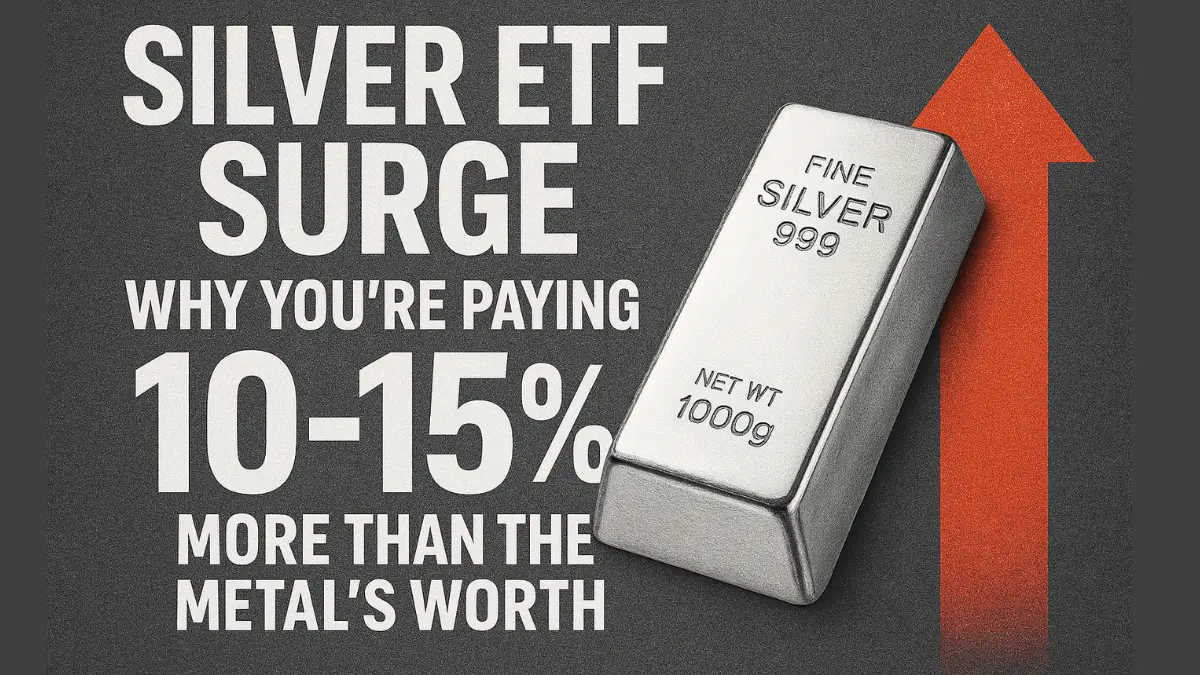


In an extraordinary turn of events, India’s silver market is currently witnessing a severe supply-side disruption even as demand surges unabated. The catalyst: a blistering rally in silver prices, which has pushed ETFs (exchange-traded funds) to trade at steep premiums of 10–15% above their intrinsic values. This anomaly has forced several mutual fund houses to pause fresh inflows, raising red flags about market distortions and investor risks.
The Surge: Why Silver Is Exploding in Value
Silver’s ascent in 2025 has outpaced that of gold and many other assets. In global markets, silver has soared by 70–90% year to date, driven by a potent mix of safe-haven demand, inflation hedging, and growing industrial consumption (especially in solar, electronics, and renewable energy).
But the rise is not restricted to international markets alone. In India, silver prices have climbed dramatically. For example, silver crossed ₹1,85,000 per kilogram during recent trading sessions. ([The Economic Times][2]) Meanwhile, gold too is rallying—crossing ₹1,30,000 per 10 grams—reinforcing the trend of precious metals becoming high-demand assets during periods of inflationary pressure and macro uncertainty. .
These developments underscore how silver is no longer seen purely as a “poor man’s gold” but as an asset with dual appeal: safe-haven undercurrents and industrial utility.
The Supply Squeeze: Why ETFs Are Overheating
While demand has soared, supply has largely failed to keep pace. A key reason: most silver is mined as a byproduct of other metals like copper or lead. Because of that, silver production doesn’t respond quickly to price incentives, which constrains its ability to expand output even when prices spike. Some estimates suggest that global deficits in silver have persisted for four straight years.
In India specifically, the physical availability of LBMA-certified bars (the only kind allowed for ETF backing) is extremely constrained. Market makers and custodians are struggling to source this certified silver to back new ETF units, leading to steep premiums. For instance, the Mint reports that silver ETFs are trading at an approximate 10% premium above their indicative NAVs. The Economist has flagged premiums in the 9–13% range on certain ETFs
Additionally, India faces structural disadvantages. Import duties, logistical costs, and taxes inflate the base cost of silver relative to international benchmarks. Combined with surging festive and wedding-season demand, the gap between domestic and global pricing has widened significantly.
ETF Dislocation: The 10–15% Premium Paradox
Under normal conditions, ETFs trade at small premiums or discounts to their NAV (net asset value), reflecting minor frictions. But in the current environment, silver ETFs in India are trading at 10–15% premiums, which is highly abnormal.
This means investors buying into such ETFs are effectively paying more than the proportional value of the underlying metal. Several mutual fund houses—Kotak, UTI, SBI, Tata, and Axis, among others—have reacted by suspending new lump-sum inflows into Silver FoF (fund-of-funds) schemes until conditions stabilize. The rationale: prevent investors from overpaying and shield funds from valuation mismatches.
While new subscriptions are restricted, SIPs, redemptions, and switch-outs are being honored under existing rules.
Analysts warn that the premium may correct—or even reverse—if silver prices stagnate or if supply constraints ease. In such a scenario, ETF holders could see mark-to-market losses as the dislocation unwinds.
Broader Impacts: Industry & Jewelry Pressure
The supply stress is spilling beyond ETFs. Jewellers and bullion traders are reporting spot shortages and steep spot premiums in physical silver markets. ([Reuters][3]) In Ahmedabad, traders have even halted new silver orders, citing lack of availability and difficulty sourcing bars. Spot premiums of ₹2,000–₹3,000 per kg are being quoted above regular rates, and delivery timelines are being stretched to several days.
Moreover, the scrap silver supply is drying up, as existing holders are understandably reluctant to sell in a rising market. ([Reuters][3]) This exacerbates the physical shortfall, especially during the festive season when demand for silver coins, bars, and tableware traditionally surges in India.
Risks, Uncertainties & Potential Moderation
Though the current state resembles mania, the rally is not without risks.
- Premium correction: If silver prices plateau or retrace, the premium baked into ETFs could collapse, leading to losses.
- Supply response: Over time, marginal producers and mines may divert resources or expand silver output—albeit—albeit—albeit slowly—whichould ease shortages.
- Regulatory or tax interference: Given silver’s rising prominence, fiscal authorities may intervene (e.g.,, with import tariffs or restrictions), which could distort the rally.
- Speculative blow-off: At these extremes, markets may be vulnerable to sharp reversals, especially if sentiment turns. Some commentators warn that this rally exhibits a strong FOMO (fear of missing out) component.
What Should Investors Do?
Given the anomalies, retail and institutional investors should tread cautiously.
- Delay fresh allocations: Waiting for premiums to subside or for ETF valuations to realign with physical silver might reduce downside risk.
- Use SIPs cautiously: Systematic investment plans spread risk over time; they may still be viable, but with awareness of distortions.
- Prefer physical holdings (if accessible): In markets where buying bars or coins is feasible, investors might bypass the ETF premium. But bear in mind storage, authenticity, and liquidity issues.
- Track premium dynamics: Closely monitor the premium over NAV; dramatic compressions could signal reversals.
- Diversify exposure: Don’t over-concentrate in silver; maintain exposure to more stable assets as a hedge.
Conclusion: A White Metal Frenzy with Warning Signs
Silver’s spectacular run in 2025 has pushed it beyond the realm of typical commodity rallies. The steep premiums on ETFs—10–15% above their net asset values—reflect an unusual and extreme dislocation between physical supply and investor demand. Meanwhile, mutual funds’ decision to freeze new subscriptions is a pragmatic but telling response to the distortion.
For now, holders of existing silver exposure may ride the wave, but new entrants must proceed with caution. A correction in premiums or a softening in price momentum could quickly turn this white-hot rally into a painful lesson. In markets driven by exuberance, timing often turns out to be everything.
Also read:
The Mahindra Bolero 2025 launched with smart features, 7 seats, and 36 km/L mileage for ₹8,950 EMI!
Royal Enfield Classic 250 Set to Launch: Budget Cruiser with 40km Mileage