The modern business landscape is aggressively shifting toward data-driven consumer engagement, making a BBA in Marketing one of the most highly sought-after undergraduate degrees this year. As companies worldwide transition from traditional advertising to targeted digital outreach, the demand for young professionals who understand consumer psychology, brand management, and market analytics has skyrocketed.
Whether you are aiming to lead campaigns at a multinational tech giant or planning to scale your own startup, this three-year undergraduate program provides the fundamental toolkit required to drive revenue and build lasting brand loyalty. This comprehensive guide breaks down everything an aspiring student needs to know in 2026, from navigating competitive entrance exams and understanding the core syllabus to exploring the long-term career scope and expected salary packages.
Why a BBA in Marketing is the Ultimate Degree for 2026
The definition of marketing has fundamentally changed. Today, it is no longer just about creating catchy slogans or booking billboard space. We are living in an era dominated by algorithmic social media feeds, artificial intelligence, and hyper-personalized consumer data.
A specialized BBA in Marketing bridges the gap between creative communication and hard business analytics. Companies are actively searching for hybrid talent—professionals who can write a compelling brand story while simultaneously interpreting complex data on customer acquisition costs (CAC) and return on ad spend (ROAS). Because marketing is the direct revenue engine of any business, graduates in this specialization frequently enjoy faster upward mobility in the corporate hierarchy compared to their peers in pure administrative or operational roles.
(Internal Link Suggestion: Read our deep-dive analysis on how AI is reshaping entry-level corporate jobs in India this year)
Top BBA Entrance Exams 2026: Your Pathway to Premier Institutes
While many tier-2 and tier-3 colleges offer merit-based admissions based on Class 12 board marks, securing a seat in a premier institution requires clearing a competitive entrance exam. The testing landscape in 2026 is highly structured, testing students on quantitative aptitude, logical reasoning, and English proficiency.
Here are the most critical BBA entrance exams 2026 you need to track:
1. CUET UG (Common University Entrance Test)
Administered by the National Testing Agency (NTA), CUET has become the undisputed mega-exam for undergraduate admissions in India. If your goal is to study at prestigious central universities like Delhi University (DU) or Banaras Hindu University (BHU), clearing the CUET is mandatory. The exam tests candidates on language proficiency, domain-specific subjects, and a general test covering logical reasoning and general knowledge.
2. IPMAT (Integrated Program in Management Aptitude Test)
For students who are absolutely certain they want an MBA, IPMAT is the gold standard. Conducted by IIM Indore and IIM Rohtak, this rigorous exam is the gateway to their highly coveted 5-year integrated BBA + MBA programs. The exam is famously quantitative-heavy and highly competitive, but it offers a direct route into the elite IIM ecosystem right after high school.
3. NMIMS NPAT (National Test for Programs After Twelfth)
Narsee Monjee Institute of Management Studies (NMIMS) conducts the NPAT for admission to its highly regarded BBA programs, particularly at its flagship Mumbai campus. The test evaluates students across 120 questions divided into quantitative ability, reasoning, and English language proficiency.
4. SET BBA (Symbiosis Entrance Test)
Symbiosis International University conducts the SET for admissions to its various campuses, including the popular Symbiosis Centre for Management Studies (SCMS) in Pune and Noida. The exam is generally considered slightly more accessible than the IPMAT, focusing heavily on analytical reasoning and general awareness.
Deconstructing the BBA Marketing Syllabus
The BBA marketing syllabus is strategically designed over six semesters (three years) to transform high school graduates into corporate-ready professionals. The curriculum starts with a broad business foundation before funneling into highly specialized marketing niches.
Year 1: Building the Business Foundation
The first year focuses on the overarching mechanics of how businesses operate. You cannot market a product if you do not understand the financial and economic realities of the company making it.
- Microeconomics & Macroeconomics: Understanding market forces, supply and demand, and global economic indicators.
- Principles of Management: Learning the fundamentals of leadership, organizational hierarchies, and business planning.
- Financial Accounting: Reading balance sheets, understanding cash flow, and learning how marketing budgets impact the bottom line.
- Business Communication: Developing professional presentation, email etiquette, and public speaking skills.
Year 2: Core Marketing and Operations
The second year introduces the core pillars of the marketing specialization.
- Marketing Management: The central hub of the degree, covering the 4 Ps of marketing (Product, Price, Place, Promotion).
- Consumer Behavior: A fascinating psychological study into why people buy what they buy, exploring emotional triggers and cultural influences.
- Business Law & Ethics: Understanding consumer rights, advertising regulations, and ethical marketing practices.
- Human Resource Management: Learning how to manage teams, an essential skill for future marketing directors.
Year 3: Advanced Specializations and Capstone Projects
The final year is highly specialized, focusing on modern strategies and hands-on experience.
- Digital & Social Media Marketing: Deep-diving into SEO, content strategy, Meta/Google ads, and influencer marketing.
- Market Research & Analytics: Learning how to gather and interpret consumer data using statistical tools to drive business decisions.
- Brand Management: Strategies for building, protecting, and evolving a brand’s public identity over time.
- Internship/Capstone Project: Most top programs require a semester-long project or corporate internship, providing crucial real-world experience before graduation.
Analyzing the BBA Marketing Scope
The BBA marketing scope is remarkably resilient. Regardless of economic downturns, companies must continue to sell their products and services to survive, ensuring a consistent demand for skilled marketers.
Graduates are not limited to traditional advertising agencies. The tech sector (SaaS companies, e-commerce platforms), FMCG (Fast-Moving Consumer Goods like Nestle or Unilever), banking, and even the healthcare industry actively recruit marketing graduates. Furthermore, the rise of the creator economy and D2C (Direct-to-Consumer) brands has created a massive parallel job market for young marketers who excel at digital community building.
Interestingly, there are also lucrative opportunities within the government sector. Public Sector Undertakings (PSUs) like GAIL, BHEL, and various nationalized banks frequently hire candidates for roles like “Marketing Officer” or “Assistant Manager – Marketing,” offering excellent job security and benefits.
(Check the official National Career Service portal by the Government of India for the latest public sector marketing vacancies.)
BBA Marketing Career Paths and Job Profiles
Your specific BBA marketing career path will depend heavily on your personal strengths. Creative individuals might veer towards content and branding, while highly analytical students might prefer research and data.
- Digital Marketing Specialist: Managing a brand’s online presence, optimizing websites for search engines, and running paid digital ad campaigns.
- Brand Manager: Acting as the “guardian” of a brand, ensuring all messaging, design, and public relations align with the company’s core identity.
- Market Research Analyst: Studying market conditions to determine the potential sales of a product or service. This involves heavy data analysis and competitor tracking.
- Sales Executive / Relationship Manager: Working directly on the front lines of revenue generation, managing client relationships, and closing deals (especially in B2B environments).
- Public Relations (PR) Specialist: Shaping public perception, handling media inquiries, writing press releases, and managing crisis communications.
Realities of the BBA Marketing Salary in India

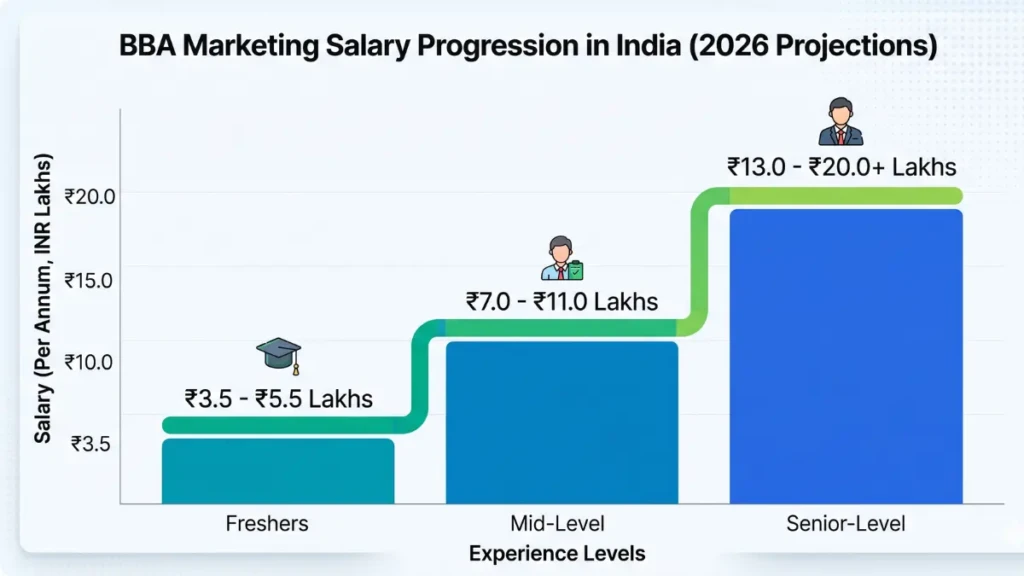
Compensation in the marketing sector is highly meritocratic. While your starting salary is influenced by the reputation of your college, your long-term earning potential is dictated entirely by your ability to drive tangible results (sales and engagement).
Based on current industry data from major employment portals, the BBA marketing salary landscape in India looks like this:
- Entry-Level (Freshers): Graduates stepping into their first roles can expect an average package ranging from ₹3,00,000 to ₹5,50,000 per annum. Those recruited by top-tier firms (like Amazon, TCS, or Deloitte) from premier colleges can secure starting packages up to ₹8,00,000.
- Mid-Level (3-5 Years Experience): As professionals prove their ability to manage campaigns and lead small teams, salaries typically jump to between ₹6,00,000 and ₹10,00,000 per annum.
- Senior-Level (5+ Years Experience): Experienced marketing managers, brand directors, and research heads can command salaries anywhere from ₹12,00,000 to over ₹25,00,000 per annum, heavily bolstered by performance bonuses and stock options.
Ultimately, a BBA in Marketing is an investment with a high ceiling. By focusing on building a diverse portfolio of digital skills, securing strong internships during your college years, and understanding the psychology of the modern consumer, you can build a highly lucrative and deeply creative career.
Frequently Asked Questions (FAQ)
What are the main subjects in a BBA marketing syllabus?
The core subjects typically include Marketing Management, Consumer Behavior, Digital Marketing, Market Research, Advertising and Sales Promotion, and Brand Management, alongside general business subjects like Accounting and Economics.
Is mathematics compulsory for BBA entrance exams 2026?
Yes, basic to intermediate mathematics is generally required. Top entrance exams like IPMAT, CUET, and NPAT have dedicated Quantitative Aptitude sections that test arithmetic, algebra, geometry, and data interpretation.
What is the average BBA marketing salary for a fresher?
The average starting salary for a fresher in India ranges between ₹3,00,000 and ₹5,50,000 per annum. Graduates from top-tier colleges or those with highly specialized digital skills can start at significantly higher packages.
Does a BBA in Marketing have good scope in the government sector?
Absolutely. Government-backed enterprises (PSUs) such as MTNL, BHEL, and public sector banks regularly hire BBA Marketing graduates for roles like Marketing Officer, Assistant Manager, and Probationary Officers, offering competitive salaries and unmatched job security.
Also Read:
UPPSC 2026 – Exam Calendar, PCS Notification, Eligibility, Fees & How to Apply