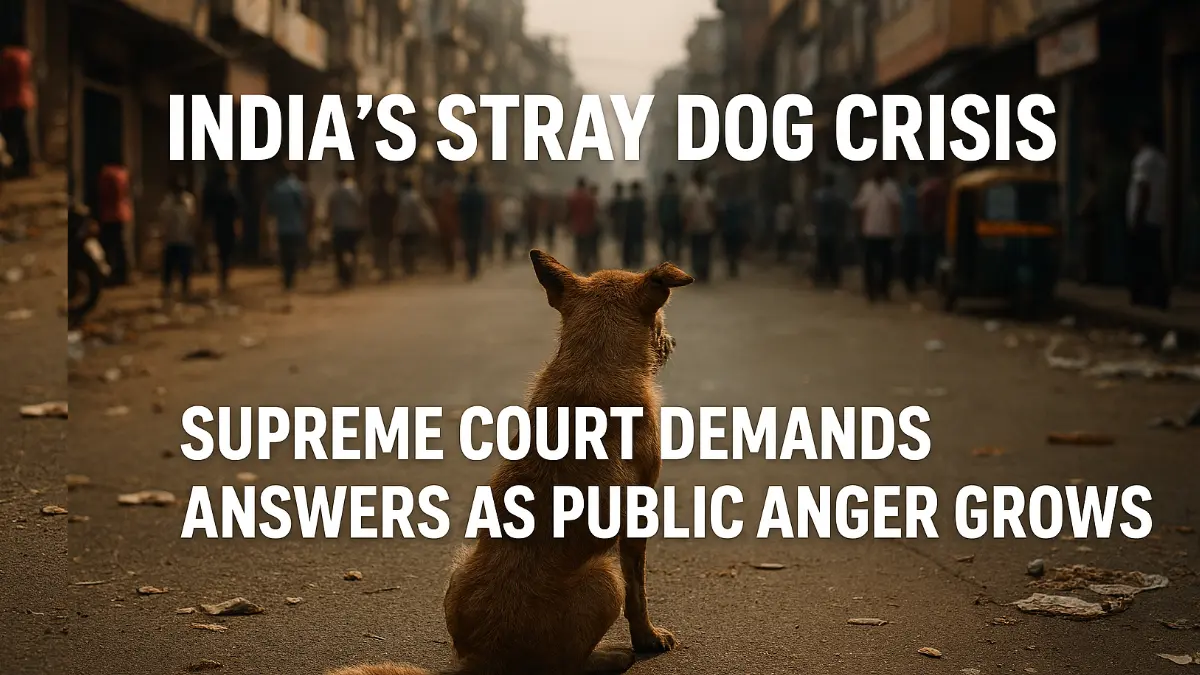

The streets of India are caught in a worsening crisis—one that pits public safety against animal welfare and has left municipalities scrambling for solutions. The Supreme Court’s recent intervention in India’s stray dog menace has brought this long-simmering issue to a boiling point, with judges demanding accountability even as they hold back on a final verdict.
A Nation Under Siege
Walk through any Indian neighborhood today and you’ll see the same scene—packs of stray dogs roaming freely, while pedestrians walk cautiously, children are kept indoors, and delivery workers carry sticks for protection. The numbers tell a grim story:
- Over 6 crore stray dogs nationwide
- Kerala reporting 1 lakh+ dog bite cases in 2024 alone
- Cities like Pune and Hyderabad seeing weekly attacks on children
“My 8-year-old now refuses to play outside after seeing a neighbor get bitten,” shares Arvind Patel, a worried parent from Mumbai. “What kind of childhood is this?”
Supreme Court Loses Patience
During contentious sessions, Justice Kaul’s bench did not mince words:
“Your sterilization records show 80% coverage, but the streets tell a different story. Either your data is wrong or your methods don’t work.”
The Court has demanded:
✔ Actual sterilization numbers (not just targets)
✔ Proof of rabies vaccination drives
✔ Details of funds allocated vs funds used
But with the verdict delayed, municipalities continue their ineffective ABC (Animal Birth Control) programs while public frustration mounts.
Two Sides of the Same Coin
Animal activists argue:
- Strays are victims of human neglect
- Mass culling violates animal rights
- Proper ABC programs work when implemented
Residents counter:
- “My right to safety trumps street dogs’ rights.”
- Sterilization drives exist only on paper
- Children and elderly live in constant fear
Veterinary expert Dr. Sharma explains, “The truth lies in between. We need scientific population control plus responsible pet ownership.”
Why Municipalities Keep Failing
Ground realities expose systemic failures:
- Corruption: Funds meant for ABC programs mysteriously vanish
- Poor Infrastructure: Most cities lack proper sterilization facilities
- Staff Shortages: Delhi has just 12 dog catchers for 6 lakh strays
- Public Apathy: People oppose shelters in their neighborhoods
As BMC official Rane admits, “We’re stuck between court orders and public anger with no real solution.”
Possible Ways Forward
Some cities offer hope:
- Indore’s GPS-tracked sterilization program
- Mysuru’s community-led adoption drives
- Chandigarh’s successful rabies eradication
But these remain exceptions rather than the norm.
What’s Next?
With the Supreme Court’s next hearing weeks away, India waits anxiously. Will the verdict:
- Order mass culling despite activists’ protests?
- Mandate better-funded ABC programs?
- Hold officials personally accountable?
One thing’s clear—this isn’t just about dogs. It’s about India’s ability to solve complex urban problems humanely and effectively. As the debate rages on social media and in courtrooms, ordinary citizens continue navigating streets where man’s best friend has become his greatest fear.
What’s your solution? Should India prioritize human safety over animal welfare? Or is there a middle path we’re missing? Share your views below.
The Human Cost: When Man and Beast Collide
The crisis is more than just numbers; it is about destroyed lives. In a heart-wrenching incident from Ghaziabad last month, 65-year-old retired teacher Mrs. Shobha Dixit was mauled by seven strays while taking her morning walk. “I needed 32 stitches and ₹85,000 in medical bills,” she recounts, showing the jagged scars running down her legs. Her story mirrors thousands across India, where dog bites have become the second most common animal-related deaths after snakebites, as per ICMR data.
Rabies: The Silent Killer
What makes these attacks particularly dangerous is India’s staggering rabies burden:
- Accounts for 36% of global rabies deaths (WHO 2024)
- 20,000 annual deaths (90% from dog bites)
- 60% victims are children under 15 years
Dr. Amit Khandelwal, a public health specialist in Jaipur, reveals the grim reality: “We still see 4-5 rabies deaths monthly because people can’t afford the ₹3,500 vaccine course after bites.”
Failed Sterilization: Why ABC Programs Flop
An RTI query exposed shocking gaps in Mumbai’s ABC program:
- Only 42% of allocated ₹18 crore actually used in 2023-24
- 7,000 sterilizations against target of 50,000
- 3 functional sterilization centers for 3 lakh strays
“Corruption eats up funds,” alleges animal activist Priya Menon. “Contractors bill for 100 sterilizations but do only 30.”
Global Lessons: What Works Elsewhere
Countries like Turkey and the Netherlands eliminated strays through:
- Mandatory microchipping of pets
- High-intensity sterilization (70%+ population)
- Fines for abandonment (₹50,000 in Germany)
- Community adoption programs
Closer home, Bhutan reduced strays by 60% through monastery-led adoption drives—a model that could work in India’s temple towns.
The Feeding Debate: Compassion or Crisis?
Animal lovers’ feeding practices often worsen the problem. Rakesh Sharma, a Delhi resident, claims, “Every day, one lady feeds 50 dogs near our park.” They’ve gotten territorial and are attacking passers-by. While the Delhi High Court’s 2021 order allows for regulated feeding, its execution is haphazard.

Tech Solutions on Horizon
Some startups are piloting innovative solutions:
- StrayMap.ai: AI-powered dog population tracking
- Pawfect: GPS collars to monitor sterilized dogs
- AdoptDesi: Crowdsourced adoption platform
But as social entrepreneur Kavya Iyer notes, “Tech can help but won’t solve systemic governance failures.”
Legal Tightrope
The Supreme Court walks a delicate balance between:
- Article 21 (Right to Life)
- PCA Act 1960 (Animal Rights)
- Municipal Laws on nuisance control
Recent state actions show diverging approaches:
- Kerala: Proposed mass culling (stayed by HC)
- Tamil Nadu: ₹15 crore for new shelters
- Maharashtra: Fines for irresponsible feeding
Voices from Ground Zero
In Bengaluru’s KR Puram, residents have started “night patrols” with hockey sticks. “The corporation does nothing,” says auto driver Manjunath. “We’ve had 12 bites in our lane this year alone.”
Meanwhile, animal rescuer Ananya Das recounts horror stories of poisoned dogs. “Two puppies died in my arms last week. This cruelty helps nobody.”
The Road Ahead
As the Supreme Court deliberates, experts suggest immediate measures:
- Audit all municipal ABC programs
- Fast-track community adoption policies
- Subsidize rabies vaccines
- Strict penalties for illegal breeding
The clock is ticking. With monsoon approaching—when dog attacks typically spike—India needs solutions that protect both its citizens and its strays. For now, the nation watches, waits, and wonders whether man and beast can ever peacefully coexist on these crowded streets.