75.7 lakh booking requests in a single day. Nearly double the normal figure. And not because India has run out of cooking gas — but because millions of households are convinced it might.
There is a crisis unfolding in India’s LPG supply chain right now. But according to the government, the crisis you are seeing on the ground — the queues outside distributors, the jammed booking lines, the three-day wait for a cylinder that used to arrive overnight — is not primarily a supply problem. It is a panic problem. And on Friday, the Centre stepped in front of the cameras to say so directly.
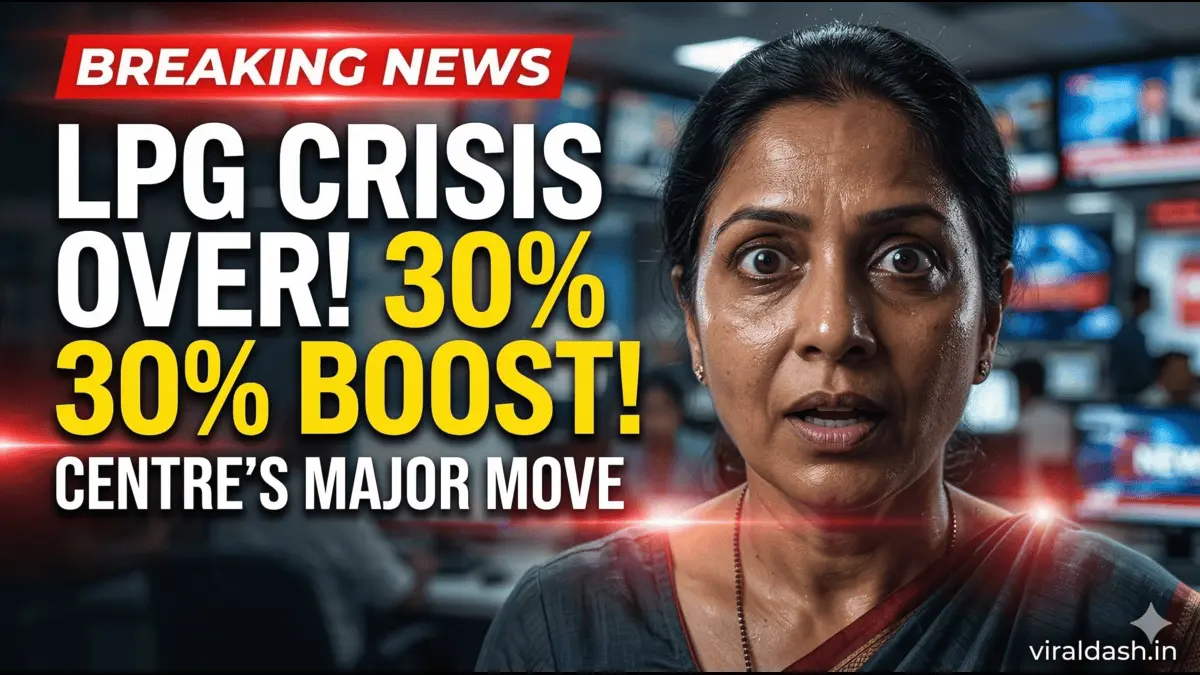
Sujata Sharma, Joint Secretary at the Ministry of Petroleum and Natural Gas, addressed the press at an inter-ministerial briefing in New Delhi and laid out the numbers in plain terms. LPG bookings across the country have surged to 75.7 lakh per day — up sharply from the pre-war average of 55.7 lakh. That gap, she said, is not hunger. It is fear. “I want to appeal to the people that there be no rumour mongering and there is absolutely no need to panic,” Sharma said. She added that under normal conditions, a booked cylinder reaches the household within 2.5 days — and that timeline, she insisted, still holds.
The message was firm. The subtext was firmer still: the system is holding, but only just — and every unnecessary booking makes it harder for the families who genuinely need a refill to get one.
How a War 2,500 Kilometres Away Reached India’s Kitchen
None of this panic emerged from thin air. India produces roughly 40 per cent of its LPG requirement domestically. The remaining 60 per cent is imported, and nearly 90 per cent of those imports transit through the Strait of Hormuz. When the US-Israel strikes on Iran began on February 28 and Tehran responded by blockading that narrow maritime passage, the arithmetic became uncomfortable very quickly. The Strait of Hormuz shutdown effectively slashed around 55 per cent of India’s total cooking gas supply almost overnight.
That is not a small disruption. India has 33 crore household LPG connections. Every single one of them sits at the end of a supply chain that, until two weeks ago, ran through a chokepoint now controlled by a country at war with India’s largest trading partner. The fear that followed is entirely understandable. What the government is now trying to prevent is that fear from becoming a self-fulfilling prophecy.
What the Centre Has Actually Done — Step by Step
The government’s response, quiet as it has been in public communication, has been fairly aggressive on the ground.
The LPG Control Order issued on March 8 directed all refineries to maximise LPG yields and channel the entire output of their C3 and C4 hydrocarbon streams exclusively to the three oil marketing companies for domestic cooking gas. In the five days that followed, domestic LPG production was increased by 28 per cent through refinery directives alone. The Centre’s overall figure of 30 per cent cited at Friday’s briefing reflects additional procurement already underway.
A Natural Gas Control Order was issued on March 9 under the Essential Commodities Act, establishing a priority allocation system. Under the framework, piped natural gas for households, CNG for vehicles, and natural gas used for LPG production all receive 100 per cent of their supply. Refineries and power plants receive 80 per cent of their previous six-month average, petrochemical and fertiliser plants 70 per cent, and other industrial and commercial users 65 per cent.
The government has also approved a ₹30,000 crore compensation package for oil marketing companies to absorb the price shock and keep household supply stable — though that has not stopped a ₹60 price hike from landing. A 14.2 kg domestic non-subsidised cylinder now costs ₹913 in Delhi, while a 19 kg commercial cylinder has risen to approximately ₹1,883.
The 25-Day Rule — What It Means for You
If you have been trying to book a cylinder and finding the system is pushing back, this is why. The minimum gap between domestic LPG bookings has been extended from 21 days to 25 days as a demand management measure to prevent panic booking from creating artificial shortages that would deprive other households of their basic needs.
In practice, this means booking a cylinder today does not guarantee it arrives any faster — it simply pulls supply away from someone else who may actually be running on empty. The government’s Delivery Authentication Code system, which now covers around 90 per cent of consumers, is being actively used to prevent diversion of domestic cylinders to commercial users, hotels, and factories.
Commercial LPG supply has been capped at 20 per cent of the average monthly allocation, delivering a 35 per cent effective cut to hotels, dhabas, roadside eateries, and community kitchens. Restaurants across Mumbai, Bengaluru, Gurugram, and Kolkata have already begun modifying menus, reducing kitchen hours, and in some cases temporarily closing. As a relief measure, the environment ministry has permitted commercial establishments to use biomass, refuse-derived fuel pellets, kerosene, and coal for one month while the LPG pipeline normalises.
On the Ground: Queues, Crashed Booking Apps, and Corporate Canteens Shutting Down
The government’s assurances have not fully translated into calm at the street level — and the reasons are not entirely irrational. Distributors have reported that the shortage is less about absolute stock and more about disrupted flows, overloaded booking technology, and confusion over export rules. Long queues have formed outside distributors in cities including Delhi and Mumbai, with booking system failures forcing many consumers to appear in person.
The ripple effects have reached unexpected corners of urban life. After Infosys, Cognizant has urged staff to consider bringing their own food wherever possible, as office canteens face fuel constraints. Induction cooktops have gone out of stock on quick-commerce platforms like Blinkit and Swiggy Instamart — a telling sign of just how quickly households are scrambling for alternatives.
India’s total annual oil consumption stands at around 189 million metric tonnes, of which nearly 47 per cent is currently affected by global disruptions. The government has been careful to note that piped natural gas and CNG for vehicles remain fully available — an important distinction, since the crisis is specifically concentrated in bottled LPG.
Diversifying Away From Hormuz — The Long Game
One of the more consequential shifts happening beneath the daily headlines is India’s rapid effort to route its energy imports away from West Asia entirely. The government has confirmed that energy procurement is actively being diversified, with imports being ramped up from the US, Norway, Canada, Algeria, and Russia. None of these routes pass through the Strait of Hormuz. Two LNG cargo shipments have already been procured from new sources and are currently on their way to India, Sharma confirmed at Friday’s briefing.
The shipping ministry confirmed that 28 Indian-flagged vessels with 677 Indian sailors are currently operating in the western sector of the Persian Gulf region, while four vessels with 101 Indian sailors are in the eastern sector. Port operations remain normal and the government is maintaining continuous monitoring of vessel movements.
The transition to alternative supply routes will take weeks to fully reflect in domestic availability. Until then, the government is asking citizens for one thing — patience, and the discipline to not book a cylinder they do not yet need.
What You Should Actually Do Right Now
The guidance from every level of government is consistent. If your current cylinder has a week or more of gas left, hold off on booking. The system is processing around 50 lakh deliveries a day and the pipeline is moving — just not fast enough to absorb an artificial demand spike of 20 lakh extra bookings every single day.
“This is an international challenge, but we remain committed to ensuring uninterrupted supply,” Sharma said, adding that the government will continue to closely monitor developments and take further steps if required.
The cooking gas is there. The production has gone up. Alternative imports are on the water. What the system needs now is not more government orders or refinery directives — it needs people to stop panic booking long enough for the supply chain to breathe.
The Strait of Hormuz has been closed for 13 days. India has handled worse. But it will handle this faster if 75 lakh daily bookings come back down to 55.
LPG cylinders are being delivered within 2.5 days of booking under normal demand. The government appeals to all households to book only when genuinely needed.
ALSO READ :
4 of 6 US Air Force Crew Killed as KC-135 Refuelling Tanker Goes Down in Western Iraq
IPL 2026 Is Here — And India Just Gave the World a Reason to Watch Every Single Ball