Paris came. Paris saw. Paris absolutely destroyed
There was a moment on Wednesday night at the Parc des Princes when it felt like Chelsea had done something genuinely extraordinary. They had fought back twice, made it 2-2, and the tie was right there — hanging in the balance, breathing, alive. Stamford Bridge was already forming in everyone’s imagination as the real battleground.
Then Khvicha Kvaratskhelia walked off the bench, and everything changed.
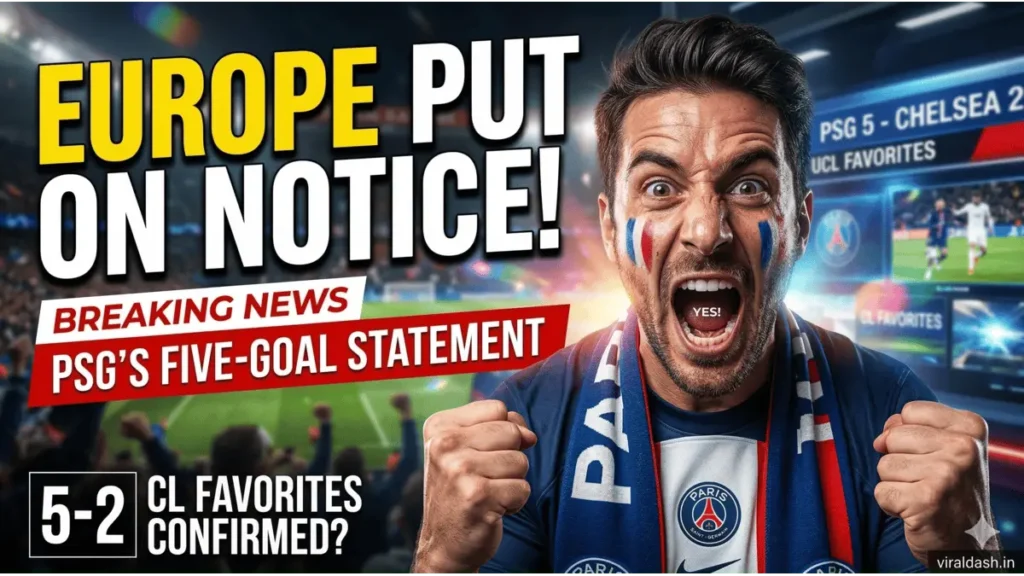
PSG didn’t just beat Chelsea. They disassembled them. And in doing so, Luis Enrique’s side sent the sharpest, loudest reminder to the rest of Europe — this team, inconsistent as they have been all season, is still a completely different animal when the Champions League knockout rounds arrive. The final scoreline of 5-2 tells the story, but honestly, even that doesn’t fully capture what happened in those last twenty minutes in Paris.
A Game of Two Very Different Halves
The first forty-five minutes gave Chelsea every reason to feel encouraged. They came to Paris not to defend and survive, but to actually play football — pushing high, pressing aggressively, and making PSG genuinely uncomfortable at the back. Liam Rosenior set his team up with real ambition, and for long stretches, it worked.
Bradley Barcola broke the deadlock in the 10th minute, finishing a slick team move with the kind of sharp, instinctive touch that has made him one of the most dangerous wide attackers in world football this season. But Chelsea didn’t flinch. Malo Gusto, the French full-back who has quietly grown into one of the Premier League’s most reliable defenders this season, found himself with a rare amount of space inside the PSG box and made no mistake — 1-1.
PSG went ahead again before the break when Ousmane Dembélé showed exactly the kind of quality that makes him both infuriating and brilliant to watch. He collected the ball wide, beat his man with ease, and finished in a way that reminded you why PSG paid what they did for him. It was the kind of goal that looks simple until you realise almost nobody else in European football could have scored it.
Chelsea kept coming, though. Enzo Fernández — who has quietly been one of the more consistent performers in a team that has blown hot and cold all season — levelled again just after the hour mark, driving a clean finish into the top corner after Pedro Neto’s clever cutback from the left. For a moment, the tie genuinely felt like it was drifting Chelsea’s way.
Then Kvaratskhelia Changed Everything
There are moments in football that shift the entire energy of a game in an instant. The introduction of Kvaratskhelia was exactly that.
The Georgian winger had been left on the bench by Luis Enrique, a decision that raised eyebrows before kick-off but one that clearly lit a fire under the former Napoli man. When he came on, you could see it immediately — the urgency, the directness, the burning desire to make a point. He attacked Chelsea’s right side relentlessly, and PSG suddenly looked like a completely different team.
The third goal came through Vitinha, capitalising on a catastrophic error by Chelsea goalkeeper Filip Jørgensen. Jørgensen — a surprise selection ahead of Robert Sánchez — played a loose pass that was cut out instantly, Kvaratskhelia squared it across the box, and Vitinha lifted a composed chip over the stranded goalkeeper. It was the moment the dam broke.
Chelsea’s legs went. Their heads dropped. And PSG, sensing it, went for the kill.
Kvaratskhelia then took matters entirely into his own hands. In the 86th minute, he picked the ball up around twenty yards from goal, shaped onto his right foot, and curled a stunning effort into the far corner — the kind of goal that draws an involuntary noise from even the most neutral observer. Then, deep in stoppage time, he did it again. A second, with PSG’s fifth, and the tie was effectively buried.
Chelsea players slumped to the turf. The Parc des Princes erupted. And somewhere in the Champions League dressing rooms of Arsenal, Barcelona, Inter Milan, and Atletico Madrid, there was a quiet, uncomfortable recognition — nobody wants to face this PSG side when it’s running like this.
What This Means for Chelsea
To be fair to Chelsea, they were not bad. They were actually quite good for seventy minutes — competitive, organized, and dangerous in transition. Pedro Neto in particular caused PSG problems all night, repeatedly exposing Marquinhos for pace and playing a key role in both equalisers.
But this is where the gap between a team that is very good and a team that is genuinely elite becomes visible. Chelsea made three errors that directly led to PSG goals across the entire match. Jørgensen’s mistake was the most damaging, but it was part of a broader pattern of defensive lapses that have haunted Chelsea in Europe this season.
Rosenior was honest about it afterwards. “The last 15 to 20 minutes were crazy, but that’s on me,” he said. “We need to be better when setbacks happen. We have shot ourselves in the foot.”
The task now is enormous. Chelsea need three goals at Stamford Bridge next Tuesday without conceding, against a PSG team that will be perfectly content to sit back, hit on the break, and let Kvaratskhelia do exactly what he just did in Paris. History, logic, and the form guide all point the same way. But football doesn’t always follow the script, and Chelsea have already proved once this season — beating PSG in the Club World Cup final last summer — that they are capable of the extraordinary.
PSG’s Defensive Problems Haven’t Gone Away
Let’s not pretend PSG are flawless, because they are far from it. Chelsea cut through their backline on multiple occasions and had chances to score more. Matvey Safonov had an uncomfortable evening in goal and really should have done better for Gusto’s equaliser. The fact that PSG scored five goals from an expected goals figure of just 0.87 tells you this was a night when almost everything that went forward went in — and that won’t always be the case.
The decision to sell Gianluigi Donnarumma to Manchester City last summer, then bring in Lucas Chevalier, who has struggled significantly in his debut season in Paris, remains one of the stranger pieces of transfer business the club has done in recent memory. Safonov is not a reliable enough option for a team with genuine ambitions of back-to-back European titles.
If PSG’s defensive frailties are exposed by a more clinical side in the quarterfinals or beyond, that is where their campaign could unravel. Real Madrid, Arsenal, and Inter Milan all have the attacking quality to punish what Chelsea couldn’t quite finish off on Wednesday.
But When They’re Like This, Nobody Can Live With Them
Here is the thing about PSG that makes them genuinely frightening as a proposition for the rest of this competition. You can be beating them, or level with them, or on the verge of a result — and then, in the space of fifteen minutes, they destroy you. They have done it before. They did it against Manchester City last January when they trailed 2-0. They did it again on Wednesday night.
That capacity to simply flip a switch and go from ordinary to overwhelming is what separates great teams from merely good ones. Barcelona, in their pomp, had it. Real Madrid have had it for decades. Now PSG, under Luis Enrique, have developed it in a way that makes them uniquely dangerous in knockout football.
Barcola, Dembélé, Kvaratskhelia, Doué — these are four attackers who, on their day, are unplayable. The combination of pace, technique, and sheer unpredictability in PSG’s forward line is something no other team in this competition can match. And the fact that Kvaratskhelia was sitting on the bench while they were already causing Chelsea serious problems says everything about the depth of quality Enrique has available to him.
The Verdict
PSG are not perfect. They never have been under Luis Enrique. This has been a season of dropped Ligue 1 points, inconsistent performances, defensive errors, and goalkeeper headaches. None of that has gone away.
But they are still the team to beat in the Champions League. They are the reigning champions. They have the most dangerous attacking unit left in the competition. And they have just demonstrated, in the most emphatic fashion possible, that when the pressure rises and the occasion demands it — they can produce moments of football that no one else in Europe is capable of replicating.
Chelsea will travel to Stamford Bridge with hope, because that is all they have left. PSG will travel to London knowing that all they need to do is score once, and the tie is finished.
The second leg is next Tuesday. But really, this one felt like it ended in Paris, sometime around the 86th minute, when Kvaratskhelia curled that shot into the net and the Parc des Princes shook.
That is why PSG are Champions League favorites. That is why nobody wants to face them. And that is why, right now, the rest of Europe should be worried.
Second leg: Chelsea vs PSG — Tuesday, March 17, Stamford Bridge. Kick-off 8:00 PM CET.
ALSO READ:
Did Israel Attack North Korea’s Embassy in Tehran? Fact-Checking the Viral Missile Strike Claim