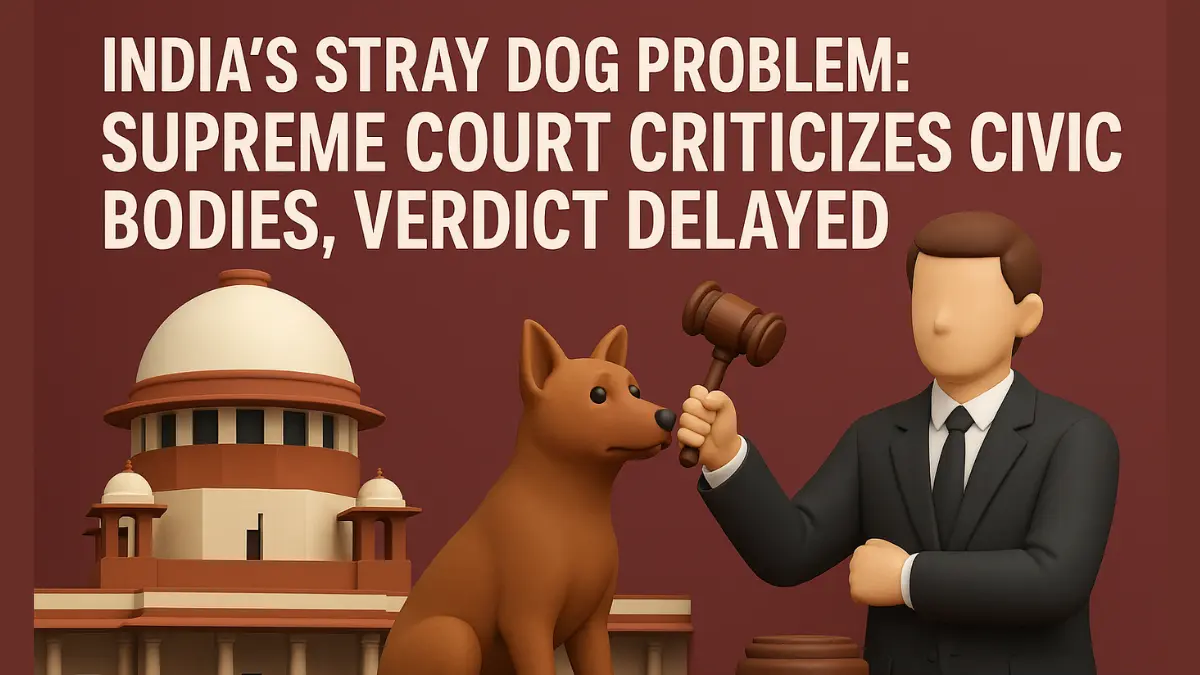
India’s Stray Dog Problem Escalates: Supreme Court Criticizes Civic Bodies, Verdict Delayed
The Supreme Court hasn’t decided yet, not on this one.
It’s about the stray dogs in Delhi and NCR. Whether they stay on the streets or get locked away in shelters. A three-judge bench—Justices Vikram Nath, Sandeep Mehta, and NV Anjaria—sat down to hear it. Big case. Big emotions.
The Chief Justice himself, BR Gavai, had stepped in earlier. There were two different rulings from two benches, clashing like badly tuned instruments. One said, “Follow the Animal Birth Control rules. Sterilize, vaccinate, and return them.” The other said, “No. Take them all off the streets.
Don’t release them back.” You can see how that wouldn’t sit quietly.
Justice Nath wasn’t impressed with the way local bodies have handled things. Or not handled. His words cut a little. No implementation. No follow-through. And now here we are—humans getting bitten, children scarred, and activists shouting for protection. “Everyone who’s here to intervene should also take responsibility,” he said. Short. Sharp.
The Solicitor General, Tushar Mehta, went hard on numbers. Thirty-seven lakh dog bites a year. That’s 10,000 every single day. Three hundred and five rabies deaths. Maybe more—WHO thinks so. He wasn’t buying the sterilization-only idea. “Dogs don’t have to be killed,” he said. “They have to be separated.” He talked about children not being able to play outside and about young girls being mutilated. His voice wasn’t soft on this.
Then Kapil Sibal stood up for the municipal corporation. He didn’t talk numbers. He talked about space. There isn’t any. No shelters. Nowhere for the dogs to go. And if you throw them all together in some compound, they’ll fight. Dogs are territorial. It’s in their bones. He asked, if sterilized dogs can’t go back, then where?
Abhishek Manu Singhvi added his bit. According to government data, Delhi, Goa, and Rajasthan have had zero rabies deaths since 2022. Zero. He brushed away the notion that Delhi simply does not have the facilities to house thousands, let alone lakhs, of dogs. “If the shelters were already there,” he said, “this wouldn’t even be a problem.”
All this because earlier in the week, Justices JB Pardiwala and R Mahadevan ordered something big. They wanted every locality to be free of stray dogs. Every dog caught is kept in shelters and never released. They gave the authorities eight weeks to build shelters and report back. They also warned: interfere, and you’ll face contempt charges.
They weren’t speaking softly either. They said public interest comes first. Emotion shouldn’t cloud the job.
But it clashed with another bench’s earlier order. That one, with Justices Sanjay Karol and JK Maheshwari, leaned on compassion. They said, “No killing.” Follow the ABC Rules. That’s the law. Treat animals with care—it’s even a constitutional value. And then came the outcry. Animal activists. Politicians. Celebrities. They said this wasn’t possible. Not in two months. Not in two years, maybe. Delhi has about three lakh dogs. You’d need 3,000 shelters. That’s about Rs 15,000 crore. Where would that come from?
Maneka Gandhi, never one to hold back, warned of side effects. Remove the dogs, and other animals will take over. “Three lakh puppies from Ghaziabad and Faridabad will drive in within 48 hours because Delhi has food,” she stated. “Remove the dogs, and the monkeys will come down. In Paris, when they removed dogs and cats, rats took over the city.” She calls dogs “rodent control animals.”
Supporters of the relocation order say, “Fine, but what about the people?” The kids were bitten on their way to school? The elderly attacked during a morning walk? They don’t want to wait years for sterilization programs to work.
Sterilize. Vaccinate. Return the dogs to their spots. But those rules? They’ve been poorly enforced. That’s why the population keeps growing. That’s why the bites keep coming.
So the court listens. And waits. The relocation order technically still stands. But the judges know it’s not simple. They can see both sides—the fear of rabies, the reality of bites… and the cruelty of mass confinement.
It’s a mess. And the Supreme Court’s job now is to clean it up without making a bigger one.