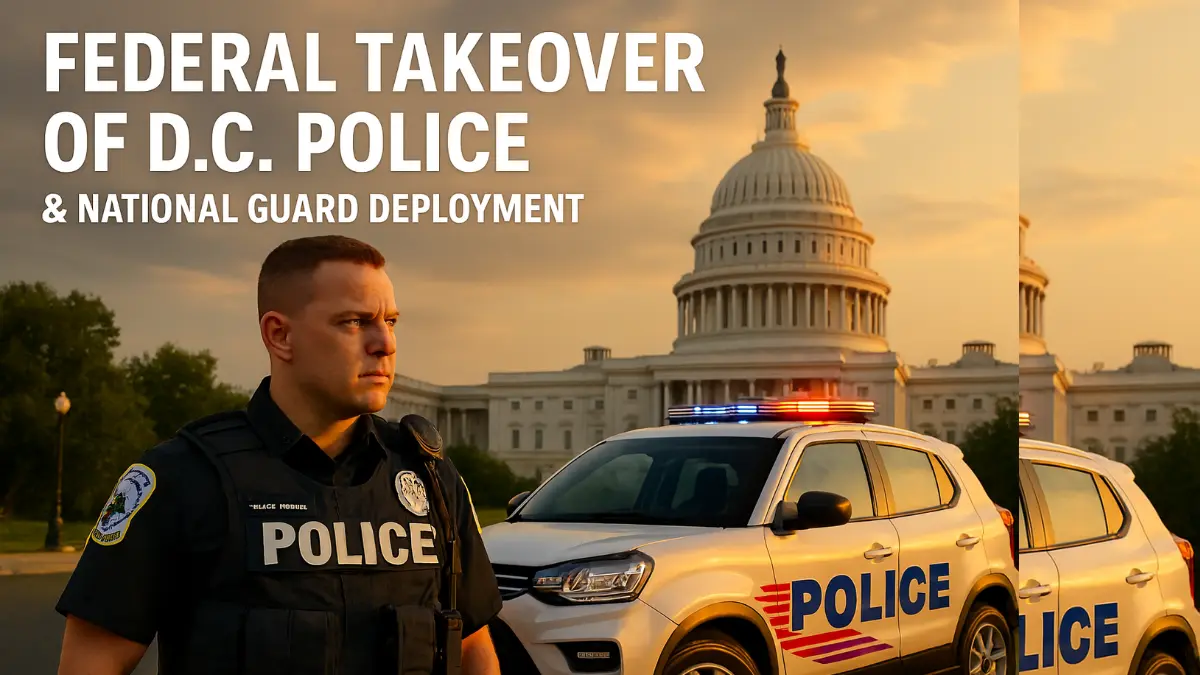

- On August 11, 2025, President Trump invoked Section 740 of the D.C. Home Rule Act, declaring a public safety emergency and placing the Metropolitan Police Department (MPD) under temporary federal control for up to 30 days, with Attorney General Pam Bondi overseeing the operation.
- The plan included sending 800 National Guard troops to help with patrols and stop crime from getting worse. He called the decision “Liberation Day in D.C.”
Legality & Power Dynamics
- The Home Rule Act authorizes the president to deploy the MPD for federal purposes during an emergency, with congressional notification required within 48 hours. Extending the control beyond 30 days would require congressional approval.
- Trump’s authority over the D.C. National Guard is unique. Unlike state guards, it is always under presidential command, and its deployment for law enforcement purposes doesn’t violate the traditional Posse Comitatus limitations.
Crime vs. Rhetoric
- Trump characterized D.C. as overrun by crime and homelessness, asserting the city was one of the most dangerous in the world. His plan includes removing homeless encampments by offering shelters, providing access to services, or imposing fines or jail time for non-compliance.
- However, crime data presents a contrasting narrative: violent crime in D.C. is at a 30-year low, with homicides down around 12% from 2024, and the overall trend shows improvement.
Local Reaction & Coordination
- Mayor Muriel Bowser called the action “unsettling” but acknowledged the legality, emphasizing that the MPD remains structurally independent and operational under Chief Pamela Smith. On the initial night of these federal operations, around 850 agents were involved, resulting in 23 arrests and the seizure of six firearms (New York Post).
- Chief Pamela Smith expressed willingness to cooperate, particularly targeting illegal firearms and crime hotspots. On the first night of federalized patrols, about 850 federal agents were active, resulting in 23 arrests and the confiscation of six firearms.
- Additionally, Eleanor Holmes Norton called the decision a historic blow to D.C.’s independence and a false picture of the city’s safety, pointing to crime figures that showed things were getting better.
The Justification: Security vs. Sovereignty
Federal officials argue that the move is necessary to prevent potential threats, especially in light of recent protests, cyberattacks, and geopolitical tensions. “A top White House official stated, “We must make sure the capital stays safe and works.”. “This is not about politics—it’s about preparedness.”
But critics aren’t convinced. Civil liberties groups warn that such actions set a dangerous precedent. “When you override local governance in the name of security, you risk eroding democratic norms,” says Maya Patel, a legal analyst with the ACLU. “D.C. residents deserve a voice in how their city is policed.”
Real People, Real Impact
Beyond the headlines and policy debates, it’s the everyday citizens who feel the ripple effects most deeply. Small business owners worry about reduced foot traffic due to roadblocks and checkpoints. Parents are concerned about the psychological impact on children who now see soldiers outside their schools.
“I had to explain to my 8-year-old why there were men with guns near the playground,” says Jamal Rivers, a father from Shaw. “That’s not a conversation I ever thought I’d have.”
Even law enforcement officers are navigating new terrain. Many D.C. police officers have expressed frustration over the sudden shift in command, with some fearing that community trust—built over years—could be undermined by federal directives that feel impersonal or overly aggressive.


For more info read this article from CNN Politics
A Call for Balance
The situation in D.C. raises broader questions about the balance between security and civil liberty, federal authority and local autonomy, and protection versus presence. While the need for safety is undeniable, so is the importance of community trust, transparency, and democratic oversight.
Local leaders are calling for clearer communication and a timeline for when control might be returned to city officials. “We understand the need for coordination,” said D.C. Councilmember Teresa Young. “But we also need assurance that this isn’t a permanent shift. D.C. belongs to its people.”
What Comes Next?
As the deployment continues, all eyes are on how the federal government manages this delicate balance. Will the increased presence lead to greater safety—or will it deepen divides between citizens and those sworn to protect them?
For now, D.C. remains a city under watch—by its own residents, by the nation, and by history itself.